Professional Drain Cleaning Middle Village Queens Homeowners Trust
Sluggish sinks, standing water in bathtubs, and gurgling kitchen lines are daily frustrations that can quickly escalate into full-blown sanitary plumbing emergencies. When routine plunging fails to budge a persistent blockage, professional drain cleaning Middle Village Queens provides the heavy-duty mechanical equipment and diagnostic precision needed to clear pipes completely without damaging vintage plumbing.
Throughout Middle Village—from single-family residences along Eliot Avenue to row houses bordering Metropolitan Avenue and homes near Juniper Valley Park—residential drainage systems frequently combine vintage cast-iron stacks, galvanized steel branch lines, and modern PVC connections. Over decades of daily household use, cooking oils, soap fats, calcified scale, and tree roots accumulate inside these pipes, restricting water flow down to a narrow trickle.
Warning Signs and Underlying Causes of Drain Blockages
Understanding the root cause of slow drainage helps homeowners avoid repeated blockages:
Kitchen Grease & Food Waste
Cooking fats, butter, and food starches poured down sink drains cool and solidify along the pipe walls, creating a sticky paste that catches food debris and completely seals the line.
Bathroom Hair & Soap Scum
In showers and lavatory sinks, long hair binds with body washes and shaving creams, forming dense, fibrous mats inside P-traps and pop-up assemblies.
Cast-Iron Pipe Tuberculation
Aging cast-iron drain lines develop rough internal rust flakes called tuberculation. This coarse surface catches toilet paper and waste, leading to chronic localized stoppages.
Main Line Sewer Obstructions
When multiple drains throughout the house back up at once, the problem lies in the main building drain or exterior lateral, requiring sewer line repair or heavy main-line rodding.
Professional Drain Cleaning Methods: Snaking vs. Hydro Jetting
Different blockages require specialized mechanical approaches rather than harsh grocery store chemical liquids:
Electro-Mechanical Cable Snaking
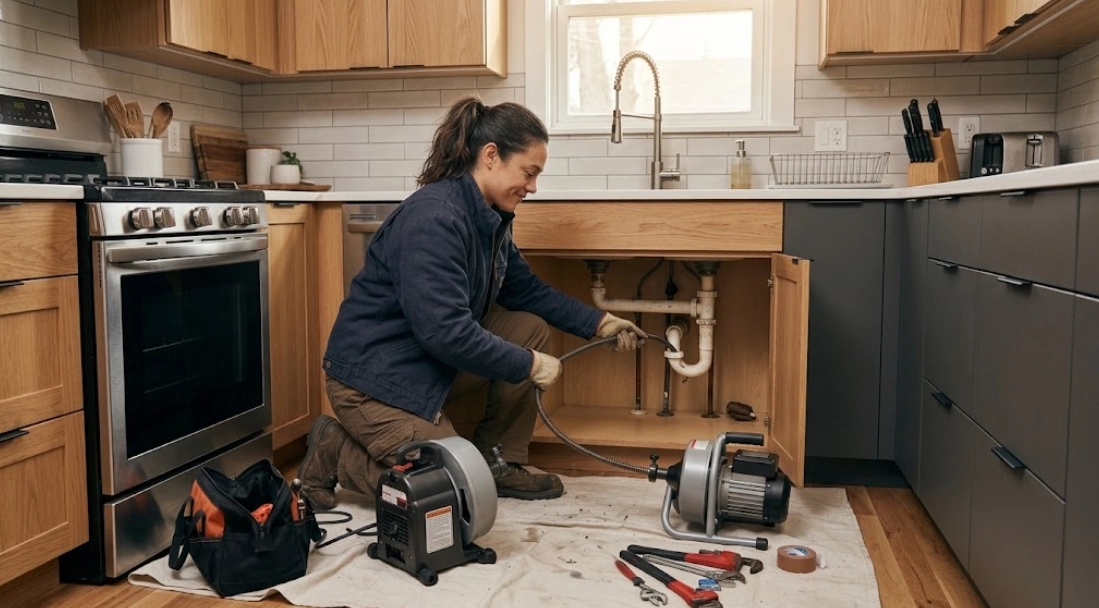
For branch lines, a variable-speed motorized drain snake feeds heavy spring-steel cables fitted with specialized cutting heads into the pipe, grinding through solid clogs and retrieving hair clumps.
High-Pressure Hydro Jetting
For dense grease, sand, or heavy sludge buildup, hydro jetting propels streams of water at pressures up to 4,000 PSI through specialized rotating nozzles, scouring pipe walls 360 degrees back to original diameter.
Fiber-Optic Camera Verification
Where blockages recur, a compact video camera is pushed through the cleanout to verify that roots or cracked pipes aren't the underlying culprits.
Trap Servicing & Flow Testing
Fixtures are flushed under maximum volume to verify rapid swirling drainage, clean trap reassembly, and zero joint seepage.
Comprehensive Residential Fixture & Plumbing Support
In addition to specialized drain clearing, our plumbing technicians handle associated residential fixture repairs—including rebuilding running toilets, replacing dripping kitchen and lavatory faucets, replacing worn wax rings, and repairing aging copper water service lines when necessary.
Clearing Versus Drain Line Replacement
When Cleaning is Sufficient
If slow drainage is caused by organic debris, grease, hair, or minor root infiltration within structurally sound piping, snaking or jetting clears the obstruction completely and restores normal function.
When Sectional Replacement is Needed
If camera diagnostics reveal that galvanized steel branch pipes are choked with internal mineral calcification or cast-iron lines have rotted through at the bottom, replacing the deteriorated pipe section with modern PVC is the only permanent solution.
Factors Influencing Drain Cleaning Investments
- Location & Access Point: Clearing a sink clog through an accessible P-trap versus pulling a heavy toilet to snake through a soil stack or entering through an exterior basement house trap.
- Method Deployed: Standard electro-mechanical cable snaking versus comprehensive high-pressure hydro jetting with camera inspection.
- Severity & Material: Clearing soft food residue versus cutting through dense tree root taproots or solidified tile grout.
Practical Tips to Prevent Household Drain Clogs
- Wipe Grease with Paper Towels: Never pour cooking oils or bacon grease down the kitchen sink. Wipe pans with paper towels before washing.
- Use Mesh Drain Strainers: Install inexpensive stainless steel mesh baskets in tub and shower drains to catch hair before it enters the plumbing trap.
- Flush with Hot Water: Once a week, pour a large pot of boiling water down the kitchen sink to melt away minor grease films before they solidify.
Related Mechanical & Heating Services
Boiler Repair Homepage
Ensure your basement heating plant remains fully operational throughout winter cold snaps.
Sewer Line Repair
Camera inspections and underground repairs addressing severe lateral collapses and root intrusions.
Sump Pump & Flood Protection
Submersible sump pumps and battery backups to safeguard basements against storm flooding.
Service Areas
Review service coverage across Middle Village, Maspeth, Glendale, Rego Park, and Ridgewood.
Frequently Asked Questions: Drain Cleaning
Why are store-bought liquid chemical drain cleaners discouraged?
Over-the-counter chemical drain openers contain corrosive sulfuric acid or sodium hydroxide. In vintage Middle Village homes with older cast-iron and lead-joint drainage, these caustic chemicals generate intense heat that eats away at pipe walls, weakens joints, and rarely dissolves dense grease or tree roots, leaving standing hazardous chemicals in your pipes.
What is the difference between mechanical snaking and hydro jetting?
Mechanical drain snaking uses a flexible steel cable with spinning cutting blades to puncture and extract stubborn localized obstructions like hair clogs or root clumps. Hydro jetting uses high-pressure water streams (up to 4,000 PSI) to scrub the entire interior pipe wall 360 degrees, scouring away years of hardened grease, scale, and sludge.
How do I know if a clog is in an individual fixture or the main sewer line?
If only a single kitchen sink drains slowly while the rest of the house drains smoothly, the blockage is isolated to that fixture's branch line or P-trap. If using a sink causes water to gurgle or back up in a ground-floor shower, bathtub, or basement floor drain, the main building drain is obstructed.
Can recurring grease blockages in kitchen drains be permanently resolved?
Yes. Snaking simply punches a narrow hole through grease that quickly closes back up. Thorough scouring with hydro jetting or enzymatic degreasing clears the full pipe diameter. Pairing this with proper kitchen waste disposal habits prevents recurring blockages.