Precision Sewer Line Repair Middle Village Queens Property Owners Rely On
When waste water backs up through basement floor drains or laundry sinks, property owners face an urgent plumbing emergency. Persistent drain backups are rarely isolated to a single fixture; they usually signal deep-seated structural issues within the subterranean main house drain or exterior lateral. Professional sewer line repair Middle Village Queens provides the exact diagnosis and heavy-duty mechanical repair needed to protect your basement and foundation.
In residential Middle Village neighborhoods—from tree-lined avenues flanking Juniper Valley Park to dense streetscapes near Metropolitan Avenue and Eliot Avenue—many private sewer laterals were constructed decades ago using extra-heavy cast iron under the slab and vitrified clay pipe beyond the curb line. Over time, shifting glacial subsoils and invasive mature tree roots compromise these underground lines.
Warning Signs of Underground Sewer Line Failure
Recognizing early indicators of sewer line deterioration allows homeowners to act before facing extensive basement flood damage:
Multiple Fixture Backups
When flushing an upstairs toilet forces wastewater to bubble up into the basement shower or floor drain, the main underground lateral is severely obstructed.
Tree Root Infiltration
Microscopic moisture vapor escaping through mortar joints in clay pipes attracts fibrous tree roots. Roots penetrate the joints and expand rapidly, catching toilet paper and debris.
Persistent Sewer Gas Odors
Foul, sulfuric sewage smells in your cellar often indicate dried-out trap seals, broken brass cleanout plugs, or cracked cast-iron vent piping beneath the concrete slab.
Ground Depression or Soggy Lawns
An underground pipe fracture washes away surrounding soil compaction, causing localized lawn sinkholes or cracked front walkway concrete slabs.
Property Owner Responsibilities Under NYC DEP Regulations
Many New York City homeowners mistakenly believe that the municipality maintains all utility piping running under the sidewalk and street. Under NYC Department of Environmental Protection (DEP) regulations:
- Full Lateral Responsibility: The property owner is legally and financially responsible for the entire sewer lateral pipe from the building wall all the way to where it connects with the municipal sewer main in the middle of the street.
- Main House Trap & Fresh Air Inlet: NYC plumbing code mandates a double-vented house trap with a fresh air inlet near the front foundation wall. Broken trap baffles allow city sewer gas to invade the home and trap debris.
- Street Opening Permits: If excavation is required beneath the public sidewalk or roadway, work must be executed by a licensed master plumber with NYC DOT street opening permits and DEP tap authorizations.
How Sewer Diagnostics & Repairs Are Carried Out
High-Definition Camera Inspection
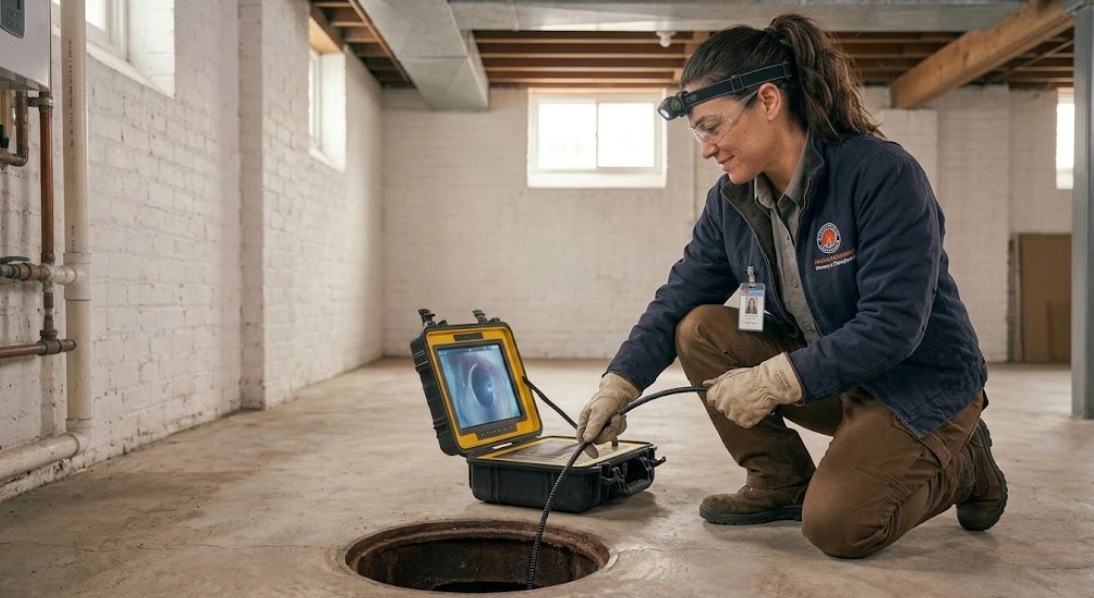
A waterproof fiber-optic camera with a 512Hz sonde transmitter is guided through the cleanout trap to capture real-time internal pipe video, recording footage of cracks, roots, or collapses.
Subsurface Sonde Locating
An above-ground digital wand receiver pinpoints the exact position and depth of the camera head under your basement floor, lawn, or sidewalk, eliminating blind trenching.
Mechanical Clearing or Heavy Snaking
If the line remains structurally sound, heavy-duty mechanical sectional snakes or hydro jetting are deployed through professional drain cleaning to clear root masses and scale.
Localized Spot Repair or Full Line Replacement
For isolated breaks, a targeted trench repair splices durable Schedule 40 PVC or extra-heavy cast iron into place using shielded mission couplings. Where lines have disintegrated, full replacement is completed.
Repair Versus Replacement: Evaluating Options
When sewer damage is uncovered, choosing between a spot repair and full lateral replacement depends on several critical factors:
When Spot Repair is Feasible
If camera diagnostics show an isolated root-penetrated joint or puncture while the rest of the pipe has thick walls and smooth pitch, a targeted spot repair saves considerable expense and minimizes concrete removal.
When Full Replacement is Necessary
If the bottom channel (invert) of vintage cast iron has rusted through, vitrified clay pipe exhibits multiple structural collapses, or severe ground settling has created massive water-holding bellies, full replacement is the permanent remedy.
Factors Influencing Sewer Line Repair Costs
Sewer project costs depend strictly on physical and regulatory site conditions:
- Depth and Burial Location: A shallow sewer line 3 feet beneath a basement slab requires modest excavation, whereas an 8-to-12-foot deep lateral beneath street asphalt requires shoring, trench safety boxes, and backfill compaction.
- Surface Restoration Requirements: Excavating through an unfinished cellar floor versus cutting and restoring patterned brick pavers, concrete sidewalks, or city asphalt road surfaces.
- Municipal Permitting & Inspection Fees: City agency fees for NYC DEP inspection sign-offs and NYC DOT roadway permits.
Comprehensive Basement Flood Protection
When municipal storm sewers become overwhelmed during heavy cloudbursts, stormwater can push backward through house laterals. Installing approved backwater valves and high-capacity sump pump systems safeguards finished basements from destructive back-pressure surges.
Connected Drainage & Heating Services
Boiler Repair Homepage
Restore central heating performance and protect basement mechanical rooms from cold snaps.
Drain Cleaning Services
Heavy-duty motorized snaking and hydro jetting for stubborn kitchen, tub, and main line stoppages.
Sump Pump & Flood Protection
Submersible sump pumps and battery backup installations to guard against basement groundwater intrusion.
Service Areas
Review service capabilities across Middle Village, Maspeth, Glendale, Rego Park, and Ridgewood.
Frequently Asked Questions: Sewer Line Repair
What are the early warning signs of an underground sewer line failure?
Frequent gurgling in basement toilets, sluggish drainage across multiple fixtures simultaneously, sewer gas odors lingering in the cellar, or sewage bubbling up from the basement floor drain whenever washing machines or dishwashers drain indicate an obstruction or collapse in the main sewer lateral.
Is the property owner responsible for the sewer line under the street in Queens?
Yes. Under New York City Department of Environmental Protection (DEP) regulations, the property owner is entirely responsible for the entire sewer lateral pipe running from the building's foundation all the way to its connection at the city sewer main in the street, including the connection spur.
How does a sewer video camera inspection help identify pipe problems?
A self-leveling fiber-optic video camera is inserted through the main cleanout trap. It transmits high-definition footage in real time, revealing exact pipe depth, distance from the house, structural fractures, tree root intrusions, bellies, or joint displacements without exploratory digging.
When can a sewer pipe be spot-repaired versus replaced entirely?
If a camera inspection shows that damage is isolated to a single localized puncture or displaced joint while the surrounding cast-iron or vitrified clay line remains structurally round and sound, a localized spot repair is appropriate. If the pipe is channel-rotted along the invert, heavily collapsed, or severely offset in multiple sections, full lateral replacement is necessary.